Process Studies
Process studies represent an exciting phase of the U.S. GEOTRACES program. While the section cruises have provided an unprecedented global picture of the distribution of trace elements and isotopes (TEIs) in the ocean, they inevitably reveal new questions about the specific processes controlling those distributions. Process studies are designed to address these questions through focused, targeted investigations of particular oceanographic environments and mechanisms — such as boundary inputs, biological uptake, or ocean-atmosphere exchange — that cannot be fully resolved from section data alone. As described in the GEOTRACES Science Plan, process studies are a critical complement to the global section program, and their implementation marks the maturation of GEOTRACES into a truly integrated approach to understanding the marine biogeochemical cycles of TEIs.
The U.S. GEOTRACES program has supported two process studies to date:
- GApr13 (BAIT) — Bermuda Atlantic Iron Time-series, Sargasso Sea, 2019
- GApr18 (STING) — Submarine groundwater discharge, Trichodesmium, Iron, and Nitrogen on the Gulf Shelf, 2023
Information about all GEOTRACES-endorsed process studies worldwide can be found on the GEOTRACES Process Studies page.
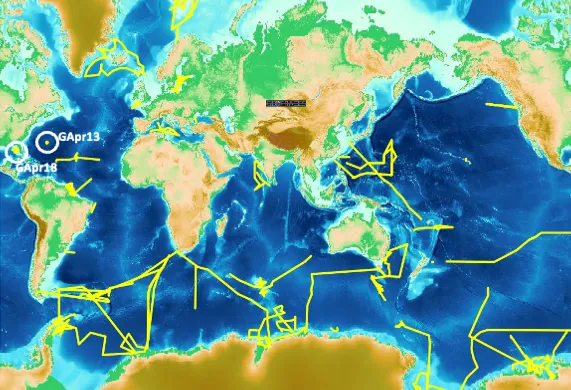
U.S. GEOTRACES Process Studies. Locations of completed U.S. process studies (white circles) overlaid on the global GEOTRACES map of completed process studies cruises (yellow lines): GApr13 (BAIT, Sargasso Sea, 2019) and GApr18 (STING, West Florida Shelf, 2023). Source: Original figure from geotraces.org/cruise-overview modified to highlight U.S. GEOTRACES process studies.
