Overview
The Bermuda Atlantic Iron Time-series (BAIT) project is a U.S. GEOTRACES process study (GApr13), jointly funded by the U.S. National Science Foundation and the UK Natural Environment Research Council. The project aims to constrain the pools, fluxes, and physicochemical transformations that control the oceanic distribution of dissolved iron (DFe), with the goal of improving the ability to model the ocean iron cycle and its sensitivity to future change.
Sampling was carried out at the Bermuda Atlantic Time Series (BATS) site and nearby spatial stations, piggybacked on the monthly BATS program cruises. The BAIT PI was Peter Sedwick (Old Dominion University), and the co-PIs were Kristen Buck (University of South Florida/Oregon State University), Rod Johnson (Bermuda Institute of Ocean Sciences), Dan Ohnemus (Bigelow Laboratory for Ocean Sciences/Skidaway Institute of Oceanography), Alessandro Tagliabue (University of Liverpool), and Ben Twining (Bigelow Laboratory for Ocean Sciences).
Four cruises were conducted across 2019, spanning a full annual cycle. Water column samples from the upper 2,000 m were collected for particulate, dissolved, colloidal, soluble, and ligand-bound iron and other trace elements, along with macronutrients and CTD sensor measurements of temperature, salinity, fluorescence, dissolved oxygen, and ancillary data from the BATS program. Also collected was a contemporaneous one-year time series of ~weekly aerosol and rainwater samples at Tudor Hill, Bermuda, for analysis of iron and other trace elements. Together, these data are being used alongside an established ocean biogeochemical model to better understand the mechanisms controlling dissolved iron distribution and dynamics in the open ocean.
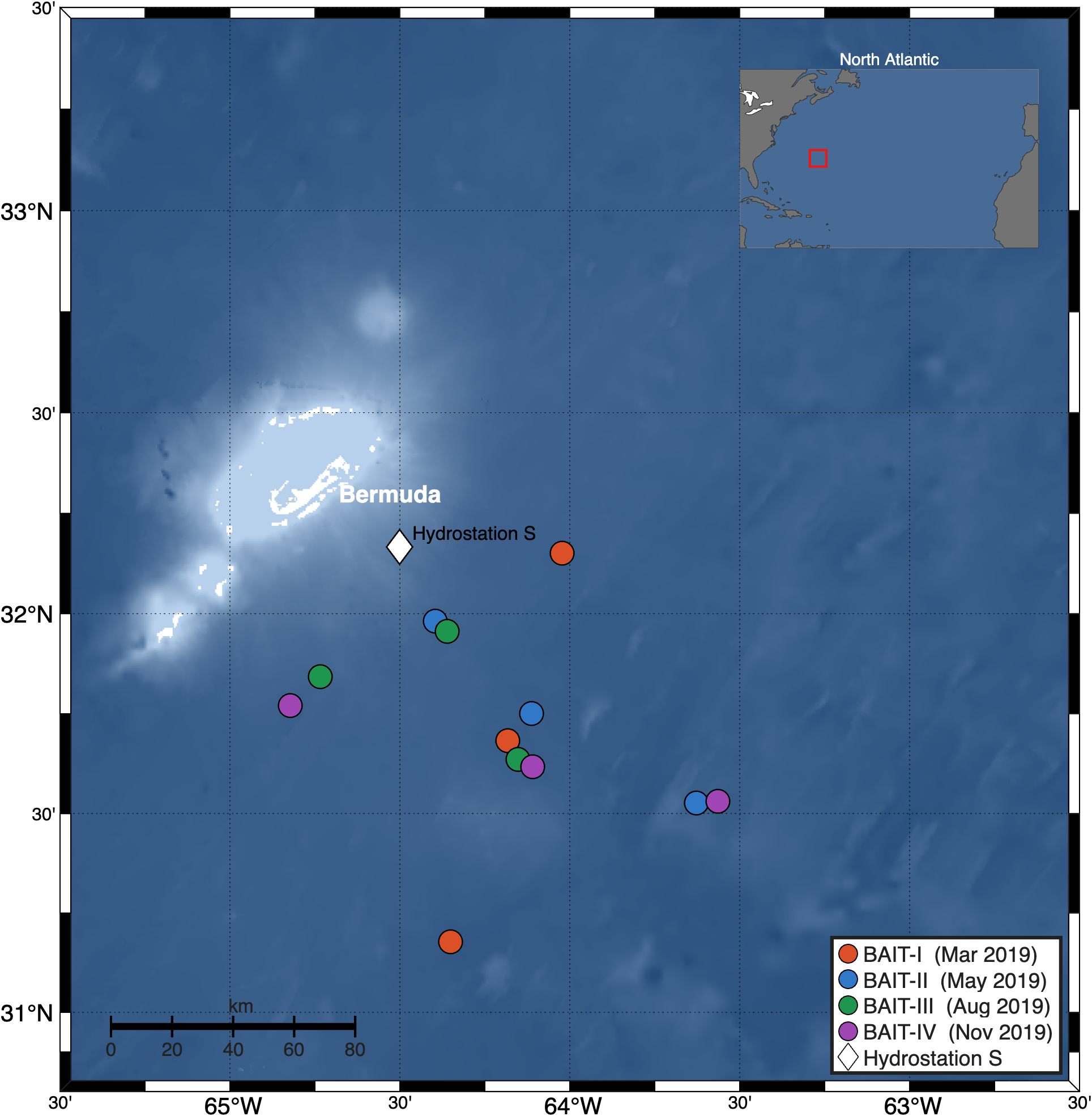
The first leg (BAIT-I, EN631, March 10–15, 2019) was conducted aboard the R/V Endeavor and captured a late-winter/early-spring snapshot of the study area. The second leg (BAIT-II, AE1909, May 11–17, 2019) aboard the R/V Atlantic Explorer captured a late-spring snapshot. The third leg (BAIT-III, AE1921, August 16–22, 2019) aboard the R/V Atlantic Explorer captured a summer snapshot, and the fourth leg (BAIT-IV, AE1930, November 15–21, 2019) aboard the R/V Atlantic Explorer captured a fall snapshot.
Major Findings, last updated May 2026
The BAIT process study investigated the supply, removal and internal cycling of iron at a site near Bermuda within the North Atlantic subtropical gyre. The study evaluated the seasonal supply of soluble iron delivered by dust, as well as the residence time of soluble iron in the euphotic zone (Sedwick et al., 2023; references listed below). The investigators showed that 10 to 30% of the particulate iron at this location is authigenic, or formed in situ from dissolved iron (Sofen et al., 2023). They also report that ligands are less important as a factor controlling the biogeochemical cycling of iron than previously thought, at least at this location, because the dissolved iron was observed to be incorporated into particulate authigenic phases that can then be exported to depth, resulting in removal of iron from the euphotic zone by abiotic processes (Tagliabue et al., 2023). Although the study mainly focused on iron, other elements were studied as well. For example, Williams et al. (2025) applied published methods to the measured inventory of dissolved aluminum in surface waters to estimate the flux of dust to this site. The calculated flux was found to be 4-9 times greater than the actual flux of dust measured at an aerosol sampling site on Bermuda, pointing to changes in the dissolved aluminum method that are needed to calculate dust fluxes.
Cruise Legs
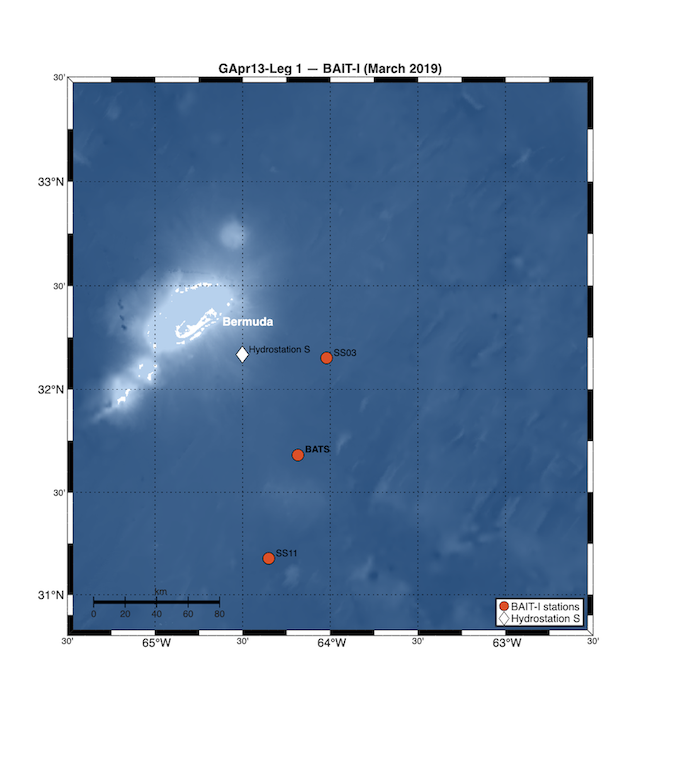
The first leg of the BAIT project (BAIT-I, EN631) was conducted aboard the R/V Endeavor from March 10–15, 2019, piggybacked on BATS cruise 357 with one extra sea day added to accommodate BAIT sampling activities. The cruise captured a late-winter/early-spring seasonal snapshot of the study area.
The Chief Scientist was Rod Johnson (Bermuda Institute of Ocean Sciences, BATS PI and BAIT co-PI). Other participants included Peter Sedwick (Old Dominion University, BAIT PI), Bettina Sohst (Old Dominion University, Research Specialist), Dan Ohnemus (Skidaway Institute of Oceanography, BAIT co-PI), Sara Rauschenberg (Bigelow Laboratory for Ocean Sciences, Research Specialist), and Shannon Burns (University of South Florida, Graduate Student).
Weather was generally favorable during the cruise, with only one evening lost to rough conditions. BAIT sampling was largely successful despite some equipment problems before and during the cruise. The crew and marine technicians aboard R/V Endeavor and the BATS program team provided invaluable assistance.
Surface mixed layers were generally in the 150–200 m thickness range, and conditions were consistent with active production, aggregation, and export of particulate organic matter before and during the cruise period. The cruise period was well timed to capture the desired late-winter/early-spring seasonal snapshot of the study location.
Water column sampling (TMCTD casts and McLane pump deployments) was conducted at BATS and at BATS Spatial Stations #11 and #3, to provide information on mesoscale lateral gradients. Sampling depths ranged from 20 m to 1,700 m, targeting the subsurface chlorophyll maximum (SCM), the dissolved oxygen minimum, and specific density surfaces. Subsamples were taken for dissolved Fe, soluble Fe, dissolved Co, dissolved Al, dissolved Fe isotopes, dissolved Fe ligands, soluble Fe ligands, cellular metals, and dissolved macronutrients.
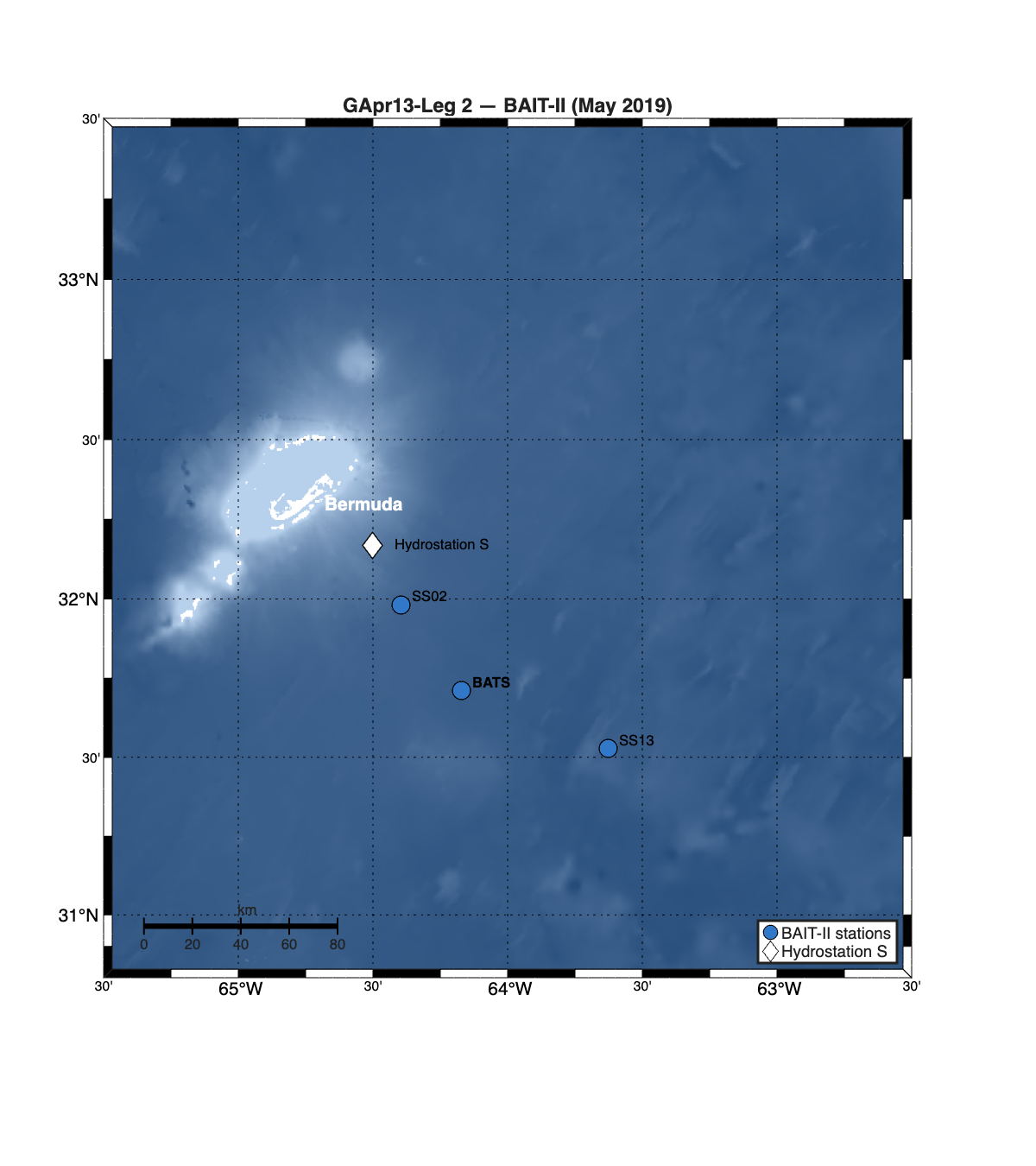
The second leg of the BAIT project (BAIT-II, AE1909) was conducted aboard the R/V Atlantic Explorer from May 11–17, 2019, piggybacked on BATS cruise 359 with two extra sea days added to accommodate BAIT sampling activities and another ancillary project. The cruise captured a late-spring seasonal snapshot of the study area.
The Chief Scientist was Rod Johnson (Bermuda Institute of Ocean Sciences, BATS PI and BAIT co-PI). Other participants included Peter Sedwick (Old Dominion University, BAIT PI), Salvatore Caprara (University of South Florida, Postdoctoral Fellow), Dan Ohnemus (Skidaway Institute of Oceanography, BAIT co-PI), Bettina Sohst (Old Dominion University, Research Specialist), Alessandro Tagliabue (University of Liverpool, BAIT co-PI), and Ben Twining (Bigelow Laboratory for Ocean Sciences, BAIT co-PI).
Weather was generally favorable, with only one day of rough weather due to a passing cold front, which did not impede science operations. The crew and marine technicians aboard R/V Atlantic Explorer and the BATS program team provided invaluable assistance.
The water column had stratified significantly since BAIT-I, with surface mixed layers of only 10–40 m. The subsurface chlorophyll maximum (SCM) was located at approximately 100 m depth or deeper. The cruise period was well timed to capture the desired late-spring seasonal snapshot of the study location.
Water column sampling (TMCTD casts and McLane pump deployments) was conducted at BATS and at BATS Spatial Stations #2 and #13, following the same sampling strategy as BAIT-I. Sampling depths ranged from 20 m to 1,700 m, targeting the SCM, the dissolved oxygen minimum, and specific density surfaces. Subsamples were taken for dissolved Fe, soluble Fe, dissolved Co, dissolved Al, dissolved Fe isotopes, dissolved Fe ligands, soluble Fe ligands, cellular metals, dissolved Pb, and dissolved macronutrients.
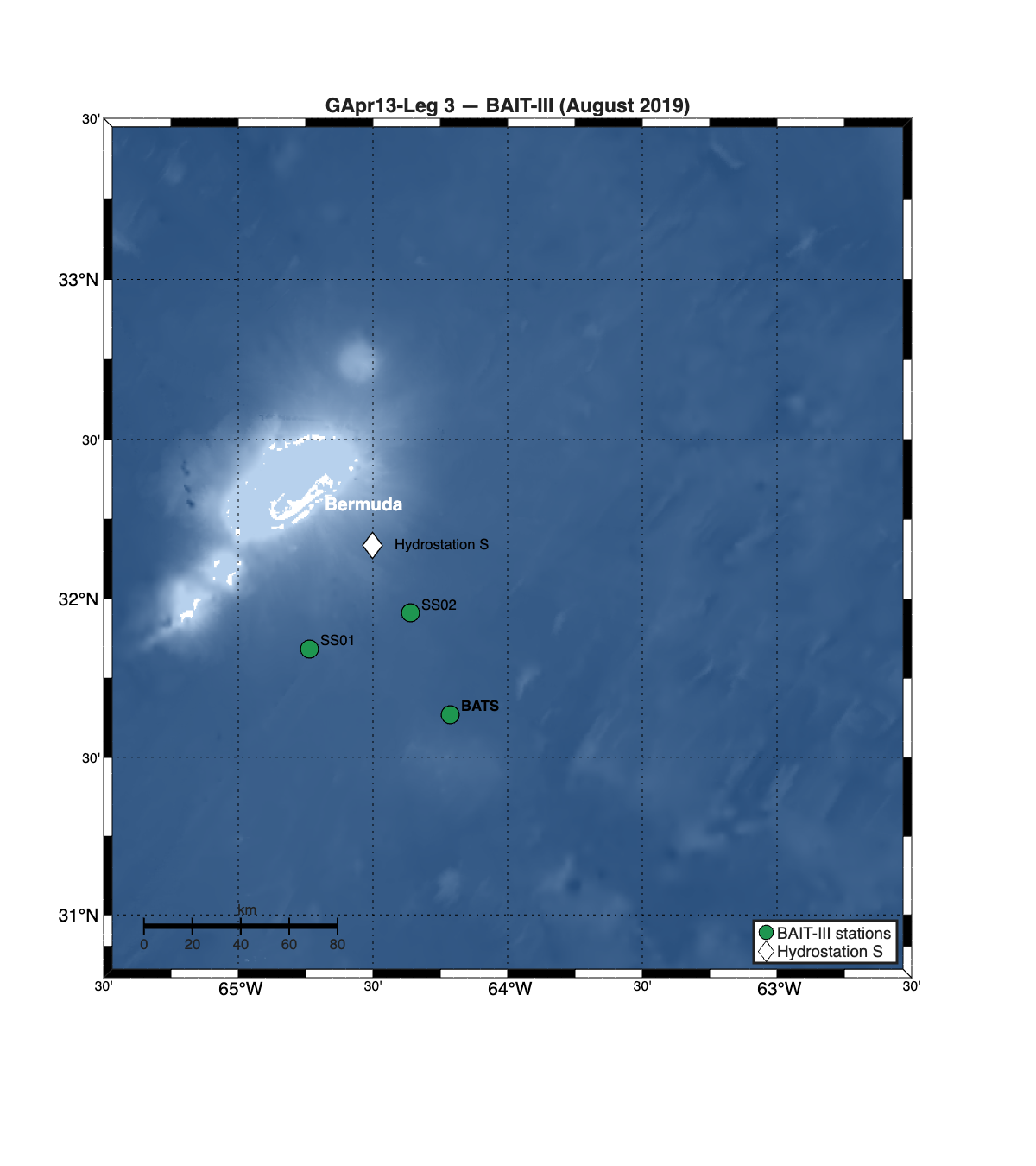
The third leg of the BAIT project (BAIT-III, AE1921) was conducted aboard the R/V Atlantic Explorer from August 16–22, 2019, piggybacked on BATS cruise 362 with two extra sea days added to accommodate BAIT sampling activities and another ancillary project. The cruise captured a summer seasonal snapshot of the study area.
The Chief Scientist was Rod Johnson (Bermuda Institute of Ocean Sciences, BATS PI and BAIT co-PI). Other participants included Peter Sedwick (Old Dominion University, BAIT PI), Shannon Burns (University of South Florida, Graduate Student), Salvatore Caprara (University of South Florida, Postdoctoral Fellow), Gabby Kim (Colby College, Undergraduate Student), Dan Ohnemus (Skidaway Institute of Oceanography, BAIT co-PI), and Bettina Sohst (Old Dominion University, Research Specialist).
Weather was favorable throughout, with sunny conditions and nearly calm winds except during the final day at sea when winds increased to approximately 10–20 knots. Despite damage to the trace metal carousel frame during the first deployment at the BATS station, temporary repairs were undertaken at sea and sampling was generally successful. The crew and marine technicians aboard R/V Atlantic Explorer and the BATS program team provided invaluable assistance.
Surface mixed layers were generally in the 10–30 m thickness range, with surface water temperatures near 29°C. The subsurface chlorophyll maximum (SCM) was typically located between 75–110 m depth and was sometimes a broad feature with more than one maximum. The cruise period was well timed to capture the desired summer seasonal snapshot of the study location.
Water column sampling (TMCTD casts and McLane pump deployments) was conducted at BATS and at BATS Spatial Stations #1 and #2. In addition, near-surface seawater samples were collected using Niskin-X samplers deployed by hand from a small boat upwind of the research vessel, augmenting the standard CTD casts. Subsamples were taken for dissolved Fe, soluble Fe, dissolved Co, dissolved Al, dissolved Fe isotopes, dissolved Fe ligands, soluble Fe ligands, cellular metals, and dissolved macronutrients.
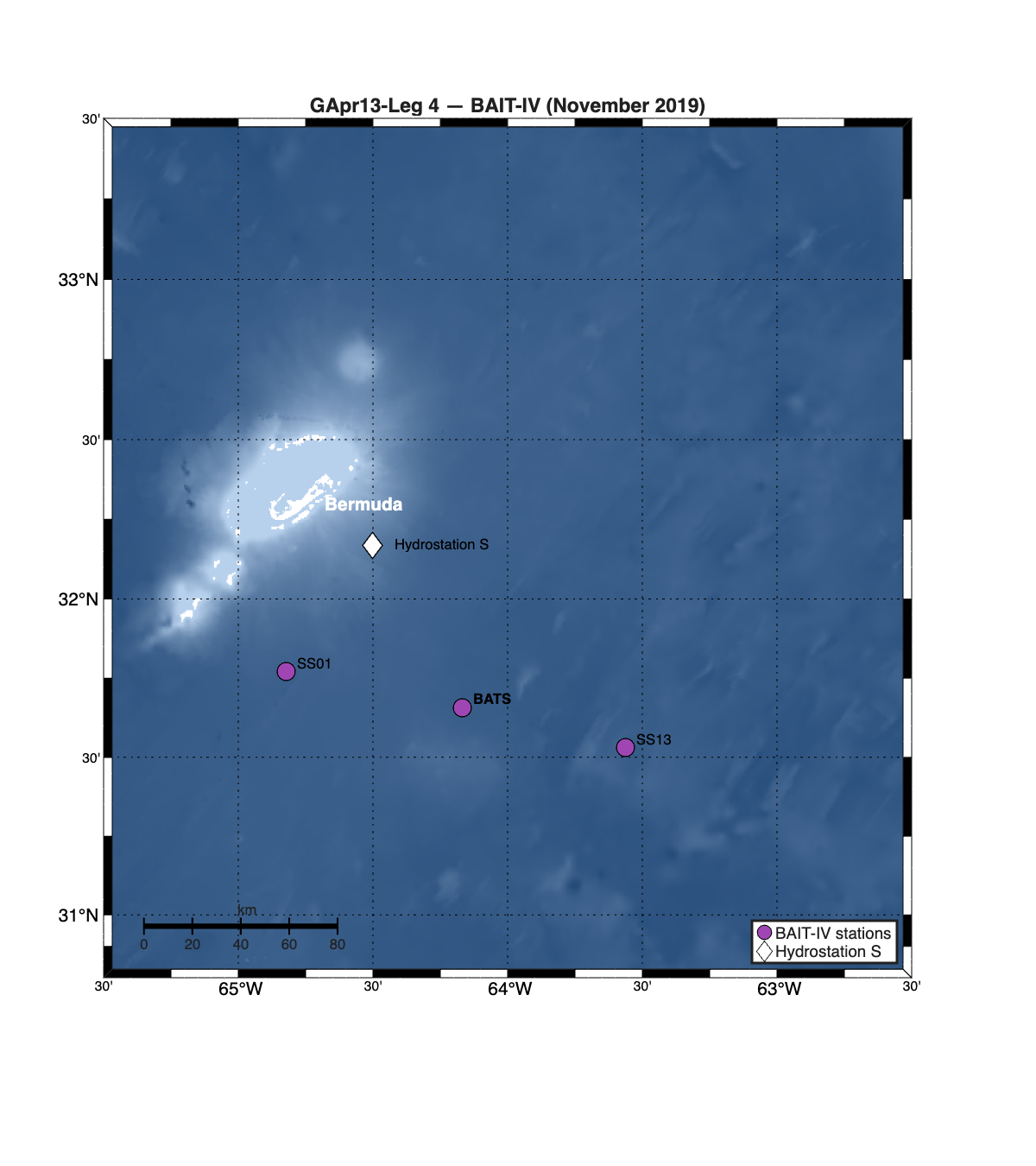
The fourth leg of the BAIT project (BAIT-IV, AE1930) was conducted aboard the R/V Atlantic Explorer from November 15–21, 2019, piggybacked on BATS cruise 365 with two extra sea days added to accommodate BAIT sampling activities and another ancillary project. The cruise captured a fall seasonal snapshot of the study area.
The Chief Scientist was Rod Johnson (Bermuda Institute of Ocean Sciences, BATS PI and BAIT co-PI). Other participants included Peter Sedwick (Old Dominion University, BAIT PI), Salvatore Caprara (University of South Florida, Postdoctoral Fellow), Lauren Chaco (Northeastern University, Graduate Student), Dan Ohnemus (Skidaway Institute of Oceanography, BAIT co-PI), and Bettina Sohst (Old Dominion University, Research Specialist).
Sailing was delayed by one day to allow for repair of the MASH2k winch. Weather at departure was a mix of sun and showers with moderate northeast winds and seas, deteriorating through November 17–18 with no work possible during the early portion of November 18 due to rough conditions. Winds and seas remained moderate to rough for the remainder of the cruise. Despite these conditions and minor damage to the trace metal CTD carousel, sampling was largely successful. The crew and marine technicians aboard R/V Atlantic Explorer and the BATS program team provided invaluable assistance.
Surface mixed layers were generally in the 50–80 m thickness range, reflecting the deepening of the mixed layer into fall. The SCM was typically located between 70–100 m depth. The rough weather pushed spatial station sampling to the latter part of the cruise, and sampling at BATS Spatial Station #1 was limited to a shallower maximum target depth due to wire angle in the rough sea conditions.
Water column sampling (TMCTD casts and McLane pump deployments) was conducted at BATS and at BATS Spatial Stations #13 and #1, following the same sampling strategy as previous BAIT legs. Subsamples were taken for dissolved Fe, soluble Fe, dissolved Co, dissolved Al, dissolved Fe isotopes, dissolved Fe ligands, soluble Fe ligands, cellular metals, dissolved Pb, and dissolved macronutrients.
Additional Resources
- Field planning workshop: University of South Florida, November 1–2, 2018.
- Project Data Synthesis Workshop: Old Dominion University, October 18–19, 2022
Cruise information and data are archived at the Biological and Chemical Oceanography Data Management Office (BCO-DMO):
Information and data are archived at Rolling Deck to Repository (R2R) Program:
- BAIT-I (EN631): https://www.rvdata.us/search/cruise/EN631
- BAIT-II (AE1909): https://www.rvdata.us/search/cruise/AE1909
- BAIT-III (AE1921): https://www.rvdata.us/search/cruise/AE1921
- BAIT-IV (AE1930): https://www.rvdata.us/search/cruise/AE1930
Sedwick, P.N., Sohst, B.M., Buck, K.N., Caprara, S., Johnson, R.J., Ohnemus, D.C., Sofen, L.E., Tagliabue, A., Twining, B.S. and Williams, T.E., 2023. Atmospheric input and seasonal inventory of dissolved iron in the Sargasso Sea: Implications for iron dynamics in surface waters of the subtropical ocean. Geophysical Research Letters, 50(6), p.e2022GL102594. https://doi.org/10.1029/2022GL102594
Sofen, L.E., Antipova, O.A., Buck, K.N., Caprara, S., Chacho, L., Johnson, R.J., Kim, G., Morton, P., Ohnemus, D.C., Rauschenberg, S. and Sedwick, P.N., 2023. Authigenic iron is a significant component of oceanic labile particulate iron inventories. Global Biogeochemical Cycles, 37(12), p.e2023GB007837. https://doi.org/10.1029/2023GB007837
Tagliabue, A., Buck, K.N., Sofen, L.E., Twining, B.S., Aumont, O., Boyd, P.W., Caprara, S., Homoky, W.B., Johnson, R., König, D. and Ohnemus, D.C., 2023. Authigenic mineral phases as a driver of the upper-ocean iron cycle. Nature, 620(7972), pp.104–109. https://doi.org/10.1038/s41586-023-06210-5
Williams, T.E., Sedwick, P.N., Sohst, B.M., Buck, K.N., Caprara, S., Johnson, R.J., Ohnemus, D.C., Resing, J.A., Sofen, L.E., Tagliabue, A. and Twining, B.S., 2025. Dust deposition to the Sargasso Sea: A comparison of estimates using aluminum in the surface ocean versus aerosols and rainwater. Geophysical Research Letters, 52(8), p.e2024GL113217. https://doi.org/10.1029/2024GL113217
Funding and Support